


AI Safety, Regulation and Building National Capacity: Prof. Petre Lameski on Sitel TV
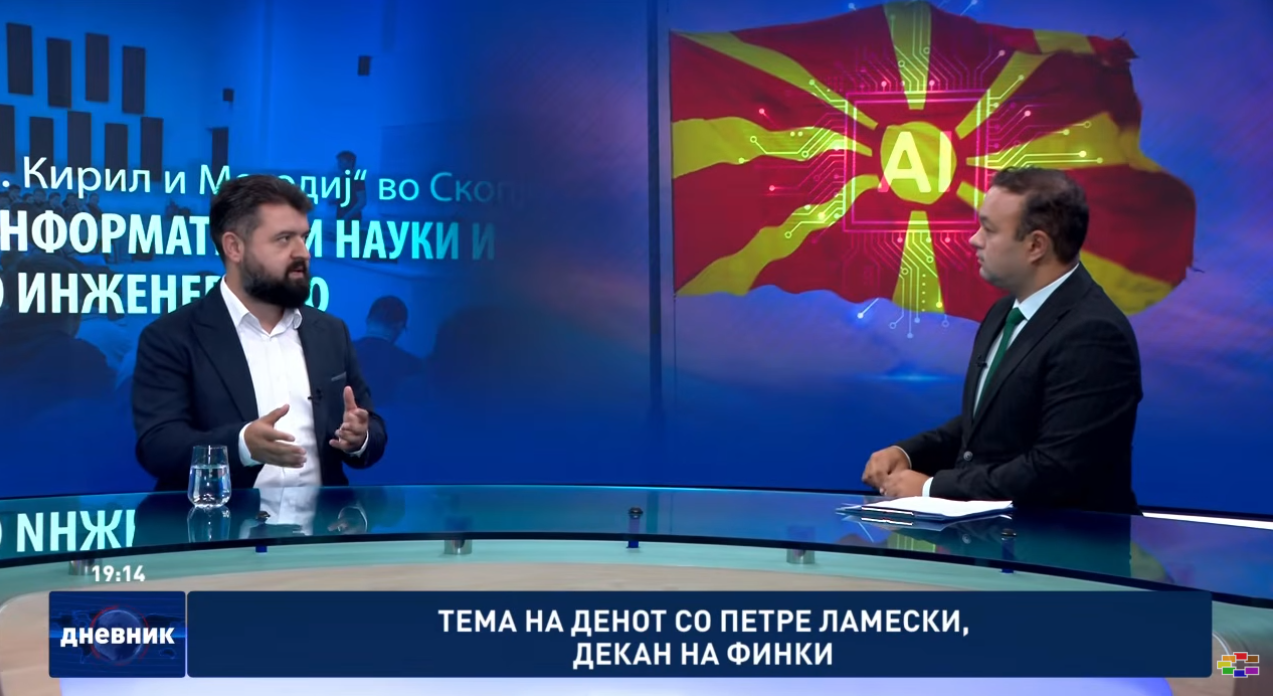
Prof. Petre Lameski, Dean of the Faculty of Computer Science and Engineering (FCSE), appeared on Sitel TV’s “Tema na denot” to discuss the security aspects of artificial intelligence, the importance of human oversight, regulation, the development of VEZILKA and the ongoing public debate around data centres.
Prof. Lameski explained that, at the current level of development, artificial intelligence should not be viewed primarily as something to fear. The greater risk comes when AI systems are given access to tools and resources and are allowed to operate without adequate control. He stressed that current models remain imperfect and that their actions and outputs should be continuously monitored and verified.
The discussion also addressed the growing reliance on AI in everyday and professional use. Prof. Lameski warned that problems can arise when users place too much trust in AI-generated results, particularly in situations where incorrect decisions may have serious consequences. His recommendation was clear: AI should remain a tool used with human supervision, rather than a system whose outputs are accepted without verification.
Another part of the conversation focused on the misuse of generative AI, including fabricated documents, images and videos. Prof. Lameski highlighted the need for appropriate legislation and internal verification mechanisms, while also explaining how greater digitalisation can improve security and transparency by creating traceable records of how documents and processes are handled.
Prof. Lameski also discussed the role of VEZILKA in strengthening North Macedonia’s capacity to use and develop artificial intelligence. Through education, support for small and medium-sized enterprises and public institutions, and connections with European AI infrastructure, VEZILKA aims to provide access to knowledge and resources needed for developing AI-based products and improving existing processes.
The interview concluded with the issue of data centres. Prof. Lameski stressed that their impact depends strongly on their size and that large facilities require appropriate energy infrastructure, careful planning and consideration of their effect on the surrounding environment. At the same time, he pointed to the value of having national computing resources for strengthening data and innovation sovereignty, while emphasising that such infrastructure should not be developed at any cost and should follow proper studies and a transparent process.
Watch the full conversation:
https://sitel.com.mk/tema-na-denot-so-petre-lameski-dekan-na-finki